MOZA R25 Ultra Wheel Base: Cockpit Integration & Performance
Choosing the right direct drive wheelbase dictates the structural foundation, thermal stability, and sensory fidelity of your entire simulator station. The MOZA R25 Ultra targets competitive drivers and dedicated simulator enthusiasts who need industrial-strength steering resistance without mechanical compromise. Instead of relying on short-burst peak ratings that fade as internal motor components heat up during…
9 min read
How we write these. Every price, stock status and specification here is read from the Amazon product listing, not from hardware we tested ourselves. Scores are out of 10, based on listed specifications and buyer feedback.


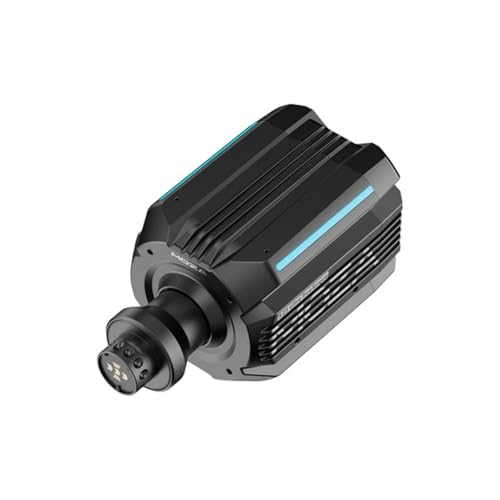
Product photos from the Amazon listing.
The product
MOZA R25 Ultra
Our score
9.0/10
Very good
Price not listed
- Prime eligible
Affiliate link. Price and stock come from the listing and change without notice.
As Amazon Associates, we earn from qualifying purchases. This means we may receive a small commission at no extra cost to you if you click through and make a purchase.
Choosing the right direct drive wheelbase dictates the structural foundation, thermal stability, and sensory fidelity of your entire simulator station. The MOZA R25 Ultra targets competitive drivers and dedicated simulator enthusiasts who need industrial-strength steering resistance without mechanical compromise. Instead of relying on short-burst peak ratings that fade as internal motor components heat up during competition, this unit is engineered around sustained torque delivery. For drivers building a permanent simulator bay or upgrading from intermediate setups, knowing how this industrial-grade motor interacts with existing cockpits, power draws, and telemetry signals is essential before mounting it to your rig.
While compact entry models like the moza r5 bundle serve desktop hobbyists well, this flagship motor is built strictly for high-load, chassis-mounted environments. In this comprehensive moza r25 ultra review, we evaluate every structural and technical aspect of the hardware using verified manufacturer data and engineering specifications. We will examine how its sustained force profile behaves under extended loads, inspect the chassis integration points, analyze the sensor and communication architecture, and help you determine whether this wheelbase matches your simulation goals.
What You Get With the MOZA R25 Ultra
The MOZA R25 Ultra is engineered as a commercial-grade, multiuse sim racing controller base focused on high fidelity and mechanical stability. Based on the manufacturer data provided by Gudsen, the core package centers around an industrial motor architecture and precision measurement sensors designed specifically for PC simulation.
In the box
- Industrial-grade direct drive wheelbase featuring a sustained 25Nm torque output
- Specialized zero-cogging flat-wire electric motor engineered for smooth rotational resistance
- True torque sensor system delivering 0.1 percent sampling accuracy and a 2 kHz response rate
- High-resolution 21-bit magnetic encoder for steering angle tracking
- Integrated telemetry communication supporting iRacing 360Hz high-frequency force feedback updates
- MOZA proprietary force feedback processing algorithm for nuanced tactile output
- Multi-angle chassis mounting architecture supporting bottom, front, and side installation configurations
- Dedicated PC hardware platform compatibility for sim racing titles
Key Specifications
Specifications
- Brand and Manufacturer
- MOZA / Gudsen
- Model Name
- MOZA R25 Ultra
- Motor Type
- Zero-cogging flat-wire direct drive motor
- Torque Output Rating
- 25Nm sustained industrial-grade torque
- Sensor Technology
- True torque sensor with 0.1% sampling accuracy
- Sensor Response Rate
- 2 kHz sampling speed
All 10 specifications
- Encoder Resolution
- 21-bit magnetic encoder
- Telemetry Protocol Support
- iRacing 360Hz force feedback update rate
- Mounting Configurations
- Bottom mounting, front mounting, and side mounting
- Platform Compatibility
- PC
Quoted from the product listing.
Chassis Rigidity and Mounting Options for High Torque
Operating a wheelbase with 25Nm of sustained output fundamentally changes how you must approach cockpit construction. Under full cornering loads in high-downforce prototypes or heavy GT3 machinery, the forces transmitted from the steering shaft pass directly into the mounting deck. If your simulator chassis incorporates thin sheet metal, unreinforced wheel plates, or cantilevered wheel decks, those forces will dissipate into structural flex rather than reaching your hands. Integrating the unit into an aluminum profile cockpit using heavy-gauge brackets ensures that the motor’s reactive energy translates into pure, unfiltered force feedback rather than chassis deflection.
To accommodate different rig architectures, the moza r25 ultra mounting options include three distinct structural interfaces: bottom mounting, front mounting, and side mounting. Side mounting and front bracket mounting are widely favored on modular aluminum extrusion cockpits because they maximize knee clearance and allow drivers to adjust tilt angles without sacrificing torsional rigidity. Bottom mounting remains fully supported for cockpits that utilize traditional horizontal wheel decks. The listing does not specify bundled mounting brackets, so drivers should ensure their rig includes or can accommodate compatible multi-point mounting plates.
A well-balanced moza r25 ultra cockpit setup requires matching hardware across all input axes. The immense steering forces generated by this base will expose any mechanical play in your seat frame, pedal deck, or monitor mounts. Drivers mounting this tier of wheelbase typically anchor it alongside rigid hydraulic or load-cell pedals, such as the moza crp2 load cell pedals, to create a stable, non-deflecting workstation capable of handling aggressive threshold braking and rapid counter-steering corrections without physical fatigue on the rig joints.
Sustained Force Feedback and Flat-Wire Motor Behavior
Understanding the difference between peak torque and continuous rotational resistance is critical when assessing the moza r25 ultra torque capabilities. Many consumer-tier direct drive bases advertise peak numbers that can only be sustained for brief fractions of a second before internal thermal limits force the motor controller to scale back power. The MOZA R25 Ultra direct drive system is specifically rated for a sustained 25Nm of industrial-grade output. This means that throughout a 45-minute sprint race or a multi-hour endurance stint, the motor maintains its full dynamic range without thermal degradation or torque clipping at mid-corner.
The internal motor architecture relies on a specialized zero-cogging flat-wire design. In conventional slotted electric motors, the rotor can exhibit subtle mechanical cogging, which creates an artificial notched sensation as the magnets pass the stator poles. By employing flat-wire winding technology and zero-cogging engineering, the R25 Ultra delivers seamless rotational travel. When turning through long, high-speed sweepers, the tactile sensation remains completely organic, mirroring the hydraulic or manual resistance of an authentic race car steering rack. This represents a significant physical refinement compared to mid-range wheelbases like the moza r21 ultra, giving competitive racers extra headroom for tire saturation cues.
Dynamic headroom is where the 25Nm sustained output truly proves its worth. Rather than running the motor at maximum gain, experienced simulator drivers often calibrate the software gain to run between 50 and 70 percent of overall power. This configuration provides a baseline steering weight that is manageable over long sessions while leaving 10 to 12Nm of instantaneous dynamic headroom above the baseline. When your vehicle hits an aggressive curb, encounters surface crests, or experiences sudden rear-axle snap oversteer, the moza r25 ultra force feedback reproduces those sharp impulses instantly without flattening the feedback curve.
Sensor Accuracy and High-Frequency Signal Processing
Raw motor strength must be balanced with precise measurement, and the moza r25 ultra specs reveal a focus on high-fidelity telemetry translation. The wheelbase features a true torque sensor that monitors output loads in real time with 0.1 percent sampling accuracy and an ultra-fast 2 kHz response rate. By measuring physical resistance directly at the shaft rather than relying solely on software estimation, the internal control loop can continuously correct for rotational inertia, ensuring that what the physics engine calculates is faithfully reproduced at the rim.
Complementing the torque sensor is a high-resolution 21-bit magnetic encoder. A 21-bit resolution divides a single 360-degree rotation into over two million individual measurement steps. This extreme granularity allows the system to register minute micro-inputs and counter-steering angles without latency or stepped interpolation. For precision drift maneuvers, oval racing line maintenance, or managing slip angle at the absolute limit of adhesion, the encoder gives the simulator software an exact reading of your physical steering position.
Processing speed extends directly to simulator telemetry integration. The R25 Ultra supports iRacing’s 360Hz force feedback update protocol. Standard simulation telemetry traditionally updates at 60Hz, which can cause high-frequency curb strikes and rapid tire scrub vibrations to feel buffered or blurred. At 360Hz, force feedback data streams to the motor controller at six times the standard rate. Combined with MOZA’s latest force feedback algorithm, this allows the wheelbase to render surface transitions, ABS pulsing, and road texture with immediate tactile clarity.
PC Integration and Ecosystem Compatibility
The MOZA R25 Ultra is engineered exclusively for the PC hardware platform. Driver installation and parameter management take place within MOZA’s dedicated software suite, where users can adjust dynamic damping, mechanical friction, speed-dependent steering ratios, and telemetry interpolation curves. Because high-output direct drive motors interact differently with different physics engines, the ability to store per-title profiles is essential for transitioning between road courses, rally stages, and oval tracks.
Regarding peripheral harmony, moza r25 ultra compatibility centers on the wider PC hardware ecosystem. While this standalone listing covers the motorized base itself, the unit links seamlessly into multi-device setups via independent USB connections. Drivers can mix and match components across the MOZA product line, pairing this high-end base with entry-level pedals such as the moza srp2 pedals or moving to professional-tier peripherals depending on their setup priorities. On PC, simulator titles recognize distinct input controllers simultaneously, giving racers complete freedom when designing their hardware stack.
Thermal management is another core operational concern for high-load home simulators. The industrial casing serves as an active heat sink, dissipating thermal energy across its metal housing during prolonged competition. The listing confirms a durable black finish and robust external shell, designed to operate in ambient room conditions without dropping telemetry packets. The listing does not specify internal audio decibel ratings or fan noise profiles, but the enclosed motor geometry is engineered for endurance operations where acoustic stability is just as critical as mechanical reliability.
MOZA R25 Ultra Pros and Cons
Reasons to buy
- Sustained 25Nm industrial-grade torque output
- Zero-cogging flat-wire motor architecture
- True torque sensor with 0.1% accuracy
- High-resolution 21-bit magnetic encoder
- Flexible front, side, and bottom mounting options
- Native iRacing 360Hz telemetry integration
Reasons to avoid
- Strictly limited to PC platform compatibility
- Requires a dedicated rigid aluminum profile cockpit
- Steering wheel rim and pedals sold separately
Check MOZA R25 Ultra on Amazon
Is the MOZA R25 Ultra Worth It
Determining whether the MOZA R25 Ultra direct drive base fits your simulation bay comes down to your cockpit construction and racing objectives. For esports competitors, endurance sim racers, and advanced drivers who demand unyielding steering resistance with zero mechanical play, this unit represents top-tier engineering. The sustained 25Nm output, 0.1 percent torque sensor accuracy, and 360Hz telemetry processing provide the dynamic headroom and micro-detail required to compete at the highest level of virtual motorsport.
However, this wheelbase is not designed for casual hobbyists or space-constrained setups. If you race from an office chair, a folding simulator frame, or a standard wooden desk, the R25 Ultra is simply too powerful. Even moderate cornering forces would easily twist lightweight mounting surfaces and compromise vehicle control. Drivers without a rigid aluminum extrusion cockpit will fail to realize the benefits of its 25Nm sustained output and would be better served by lower-torque alternatives designed for clamp-on installation.
For racers who already possess or plan to build a rigid, dedicated cockpit, the MOZA R25 Ultra delivers an exceptional blend of industrial power and fine tactile reproduction. Its multi-point mounting options ensure seamless structural integration across modern rig standards, while the zero-cogging flat-wire motor guarantees smooth, transparent resistance under the heaviest endurance racing conditions.
FAQ
Does the MOZA R25 Ultra work on gaming consoles?
No, the MOZA R25 Ultra is built strictly for the PC hardware platform. The listing specifies PC compatibility and does not support PlayStation or Xbox console architectures.
Can the MOZA R25 Ultra be mounted to a standard desk?
The listing does not specify a desk clamp, and mounting a 25Nm sustained torque wheelbase to an office desk is strongly discouraged. A motor of this caliber generates extreme twisting forces that require a rigid steel or aluminum extrusion cockpit.
Does the MOZA R25 Ultra include a steering wheel rim and pedals?
The listing is for the MOZA R25 Ultra direct drive wheelbase controller. The listing does not specify included steering wheel rims or pedal sets, meaning rims and pedals must be sourced separately as part of your overall simulator setup.
Where these numbers come from
- 581reviews published
- 1,398products with a score
- 1,374products with listed features
- 84brands covered
Ratings, prices, stock and specifications are read from the Amazon product listing. We do not run lab tests of our own, so scores on this site are out of 10, based on listed specifications and buyer feedback, not a verdict from a test bench. Prices change without notice — check the listing before buying.


