Gskyer 70mm Refractor Telescope: Practical Stargazing at Home
Beginner astronomers and space-conscious apartment dwellers often look toward the Gskyer 70mm Telescope when deciding whether a portable refractor fits their lifestyle without cluttering a small living room or balcony. Built around an optical tube with a 70mm aperture and an altazimuth mounting system, this package addresses the desire for fast, spontaneous stargazing when clear…
10 min read
How we write these. Every price, stock status and specification here is read from the Amazon product listing, not from hardware we tested ourselves. Scores are out of 10, based on listed specifications and buyer feedback.
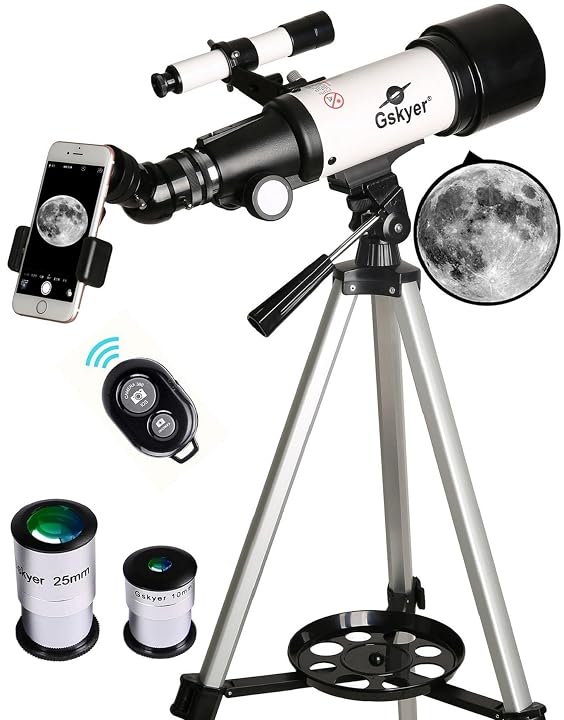


Product photos from the Amazon listing.
The product
Gskyer 70mm Telescope
Our score
8.6/10
Solid
Price not listed
- Prime eligible
- Sold by Gskyer Inc, shipped by Amazon
Affiliate link. Price and stock come from the listing and change without notice.
As Amazon Associates, we earn from qualifying purchases. This means we may receive a small commission at no extra cost to you if you click through and make a purchase.
Beginner astronomers and space-conscious apartment dwellers often look toward the Gskyer 70mm Telescope when deciding whether a portable refractor fits their lifestyle without cluttering a small living room or balcony. Built around an optical tube with a 70mm aperture and an altazimuth mounting system, this package addresses the desire for fast, spontaneous stargazing when clear skies appear unexpectedly. The gskyer telescope 70mm aperture 400mm az mount configuration aims to deliver clear views of lunar craters, bright star fields, and nearby planets without demanding the complicated calibration routines or heavy counterweights common to advanced astronomical instruments.
Deciding if this specific telescope fits your viewing habits depends on your expectations regarding manual tracking, magnification limits, and compact storage. This gskyer 400mm refractor review examines the build characteristics, optical capabilities, assembly process, and accessory performance of the kit. The following sections walk through what comes in the box, the technical specifications, real-world deployment on balconies and patios, optical clarity on celestial targets, mobile astrophotography workflows, everyday storage habits, and answers to common practical questions.
What You Get With the Gskyer 70mm Telescope
The telescope arrives as a comprehensive kit containing the optical assembly, mounting hardware, and multiple optical accessories designed to get a beginner viewing the night sky straight away without purchasing separate attachments.
In the box
- One optical tube assembly featuring a 70mm aperture fully coated glass objective lens with a 400mm focal length.
- One manual altazimuth mount equipped with an integrated panning handle for elevation and azimuth adjustments.
- One adjustable aluminum alloy tripod designed to support varied viewing heights and seated observing.
- Two replaceable eyepieces offering distinct base magnification levels for wide-field and closer observations.
- One 3x Barlow lens engineered to treble the magnifying power of each included eyepiece.
- One 5×24 optical reflex finderscope with an alignment mounting bracket and internal cross-hair lines.
- One smartphone adapter bracket that mounts directly over the eyepiece barrel for digital image capture.
- One wireless camera remote control that pairs with a smartphone to trigger exposures without touching the screen.
- One custom zippered carry bag designed to hold the optical tube, tripod, and bundled accessories together for storage.
Key Specifications
Specifications
- Optical Design
- Astronomical Refracting Telescope
- Aperture
- 70 mm (7 cm)
- Focal Length
- 400 mm (f/5.7 focal ratio)
- Optical Coatings
- Fully Coated Glass Optics with High Transmission Coatings
- Mounting System
- Manual Altazimuth (AZ) Mount
- Focusing Mechanism
- Manual Focus
All 11 specifications
- Tripod Construction
- Adjustable Aluminum Alloy
- Finderscope
- 5×24 Reflex Finder with Cross-Hair Reticle
- Field of View
- 5.8 Degrees
- Optical Tube Length
- 40 cm (15.7 inches)
- Package Dimensions
- 24.8" D x 4.92" W x 8.46" H
Quoted from the product listing.
Balcony Setup and Compact Living Footprint
Setting up an astronomical telescope in an apartment, condo, or home with restricted outdoor access introduces distinct practical hurdles. Many telescopes feature long focal tubes or bulky counterweights that bump against balcony railings, outdoor furniture, or sliding door frames. With an optical tube length of just 40 centimeters, the Gskyer 70mm balcony stargazing experience avoids these clearance headaches entirely. The short tube swings cleanly within tight confines, allowing you to position the tripod close to a ledge or window opening without losing full vertical elevation control.
The manual altazimuth mount functions similarly to a standard photographic tripod head, moving naturally up, down, left, and right. Because it does not require polar alignment with the North Star, you can place the unit down and begin visual observing immediately. This streamlined operational style contrasts sharply with motorized sky-scanning instruments like the celestron starsense explorer, which relies on smartphone docking plates and software plate-solving algorithms to orient itself. With the Gskyer refractor, pointing the tube requires only loosening the panning arm, centering the object in the 5×24 finderscope, and tightening the tension handle to hold position.
Stability remains an important variable on elevated outdoor surfaces like wooden decks or concrete balconies. The included aluminum alloy tripod is lightweight and engineered for rapid adjustment, which makes moving it through narrow doorways simple. However, that low mass means passing foot traffic, sudden wind gusts, or heavy hand pressure can cause momentary image vibration at the eyepiece. Setting the tripod legs at a lower, seated height creates a more rigid triangular base, reducing tremors and providing a steady platform for comfortable viewing sessions.
Optical Performance on Lunar and Planetary Targets
The optical foundation of this telescope rests on its 70mm glass objective lens paired with a 400mm focal length, yielding an optical speed of f/5.7. In telescope optics, fully coated glass surfaces with high transmission coatings serve two purposes: maximizing light throughput to the eye and minimizing internal reflections that degrade contrast. On the lunar surface, this lens configuration produces sharp, high-contrast imagery along the terminator line, where shifting shadows expose the structural depth of impact craters, mountain peaks, and smooth basaltic plains.
Understanding the magnification potential requires looking at the gskyer 70mm telescope specs in relation to physics. The package includes two replaceable eyepieces and a 3x Barlow lens that trebles the magnification of whichever ocular is inserted. The manufacturer rates the maximum zoom ratio at 120 multiplier x. While pushing past 100x magnification delivers larger planetary discs, smaller refractors naturally experience dimmer images and softer edges at their upper optical thresholds. When viewing Jupiter or Saturn, moderate magnification settings yield the best optical clarity, resolving Jupiter’s primary cloud belts and four Galilean moons, as well as the outer outline of Saturn’s ring structure.
Prospective stargazers should recognize the physical boundaries of a 70mm refractor when compared to larger aperture instruments such as the celestron nexstar 6se, which collects vastly more light for resolving faint deep-sky nebulae and distant galaxies. Through a 70mm aperture, bright deep-sky showcases like the Orion Nebula or the Andromeda Galaxy present as soft, glowing hazy patches rather than vivid, colorful clouds. For local solar system exploration, open star clusters, and the moon, the optical tube delivers a wide 5.8-degree field of view that makes manual tracking and sky navigation straightforward.
Mobile Photography With the Phone Adapter and Remote
Basic astrophotography has become an essential interest for many casual observers who want to document lunar craters or share sky images with family. The inclusion of a dedicated smartphone adapter and a wireless camera remote directly addresses this demand. The adapter clamps around the eyepiece barrel and secures a mobile phone camera directly over the exit pupil of the glass, translating the optical image onto the smartphone screen for direct viewing and capture.
Aligning a smartphone camera with a telescope eyepiece requires patience, especially for those new to afocal photography. The lens of the phone must sit perfectly parallel and centered over the eyepiece opening to avoid heavy vignetting or distorted edges. Utilizing the included 5×24 finder scope with its mounting bracket and cross-hair lines inside simplifies this procedure: by centering the target in the cross-hairs first, the object appears directly in the phone camera’s field of view once the focus knob is dialed in.
The wireless remote control is a critical accessory that solves a major problem in manual digiscoping. Touching a smartphone screen to press the shutter button inevitably transmits vibration down the phone adapter and into the optical tube, creating a blurred photo. By pairing the wireless shutter remote to your phone, you can step back, let the tripod settle into complete stillness, and trigger exposures cleanly. This setup works exceptionally well for high-contrast lunar photography, where fast shutter speeds freeze surface details with surprising sharpness.
Portability, Pack-Down, and Everyday Storage
A telescope that is difficult to stow or troublesome to assemble often ends up relegated to a closet corner. Examining the gskyer travel telescope storage features demonstrates how effectively this kit integrates into active living spaces. The entire system—optical tube, aluminum tripod, two eyepieces, Barlow lens, finder, and phone hardware—fits inside the bundled zippered carry bag. When packed down, the kit occupies minimal floor space, measuring approximately 24.8 inches deep, 4.92 inches wide, and 8.46 inches high.
For individuals residing in small apartments or dormitories, this compact pack-down profile is a notable advantage. The telescope does not require dedicated floor space in a living room or bedroom. It can slide horizontally under a standard bed frame, sit upright in an entryway closet, or rest inside a vehicle trunk for weekend camping trips. The total weight remains light enough for easy one-handed transport using the integrated bag straps, making it practical for transit to a local park or dark-sky site.
Following a standard gskyer telescope setup guide routine takes less than five minutes once you are familiar with the components. Assembly requires extending the three tripod legs, securing the center spreader brace, mounting the optical tube via its base screw onto the altazimuth head, and slotting the chosen eyepiece into the diagonal. Disassembly is equally rapid, allowing you to pack up immediately when cloud cover rolls in or cold temperatures end the observing session.
Gskyer 70mm Telescope Pros and Cons
Reasons to buy
- Compact 40cm optical tube for small balconies
- Fully coated 70mm glass objective lens
- Includes custom carry bag for travel and storage
- Bundled smartphone adapter and wireless shutter remote
- Simple manual altazimuth mount for fast deployment
Reasons to avoid
- Lightweight aluminum tripod sensitive to vibrations
- Manual tracking requires frequent adjustment at high magnification
- Small 70mm aperture limits faint deep-sky visibility
Check Gskyer 70mm Telescope on Amazon
Is the Gskyer 70mm Worth It
Evaluating whether this telescope represents a smart investment comes down to aligning expectations with its specific mechanical and optical profile. Choosing the gskyer 70mm for beginners is an appropriate path for first-time stargazers, families, students, or apartment residents who prioritize quick setup, light carrying weight, and dependable views of the moon and brighter planets. Having the smartphone adapter, remote, Barlow lens, and carry bag bundled in a single package eliminates the hidden expense of buying basic accessories separately.
However, serious visual observers or aspiring deep-sky astrophotographers will eventually encounter the natural boundaries of a manual 70mm refractor. Because the mount does not track celestial targets automatically, objects drift out of view at high magnification, requiring constant manual repositioning with the control handle. Enthusiasts seeking computerized automated tracking, extensive planetary imaging capabilities, or large apertures to reveal faint deep-space targets would be better served researching advanced platforms like the celestron 5se telescope, which provides motorized sky tracking at the cost of greater bulk and setup complexity.
Ultimately, is gskyer 70mm worth it for casual evening astronomy? The answer is affirmative for users who want an accessible, low-maintenance telescope that sets up on a balcony in moments, provides sharp views of our solar system neighbors, and packs completely out of sight when not in use.
FAQ
What celestial objects can you actually see with this telescope?
The 70mm aperture and fully coated glass lens are optimized for bright astronomical targets. You can expect detailed views of the lunar surface, including crater rims, mountain ranges, and rilles along the shadow line. In the solar system, Jupiter appears as an illuminated disc flanked by its four large Galilean moons, and Saturn displays its unmistakable ring system. Bright open star clusters like the Pleiades and double stars like Albireo are easily resolved. Faint deep-sky objects such as nebulae and distant galaxies will appear only as faint, gray-toned patches of light due to the light-gathering limits of a 70mm objective.
How do you align the 5×24 finderscope with the main optical tube?
Finderscope alignment is best completed during daylight hours on a stationary terrestrial target such as a distant tree branch, chimney, or street sign. Insert your lowest-power eyepiece into the main telescope tube, locate the distant object, and adjust the manual focus until the image is crisp. Once centered in the main view, look through the 5×24 finderscope and gently adjust the three mounting bracket alignment screws until the internal cross-hairs sit directly over the exact same distant target. Once aligned, objects centered in the finderscope cross-hairs at night will appear reliably in the center of the main eyepiece.
Does the telescope require batteries or an external electrical outlet?
The optical assembly and altazimuth mounting system operate entirely through manual mechanical controls, requiring no wall adapters, external battery banks, or motor drives to view the night sky. While the listing specifications mention a power source adapter, the telescope itself is purely optical and non-motorized. The only component requiring battery power is the bundled wireless camera remote, which uses an internal coin-cell battery to communicate with your smartphone via wireless signal.
How do the two eyepieces and the 3x Barlow lens work together?
The telescope includes two replaceable eyepieces that provide different levels of base magnification. Lower-magnification eyepieces offer a wider field of view, making it easier to locate objects, view large open star clusters, or scan across the broad lunar surface. The 3x Barlow lens serves as an optical multiplier: placing the Barlow lens into the focusing tube and inserting an eyepiece into the Barlow trebles the magnification of that eyepiece. This configuration expands your observing options to four distinct magnification levels without needing additional accessories.
Can this refractor telescope be used for daytime terrestrial viewing?
Yes, the refractor design makes this optical tube well suited for daytime landscape viewing, wildlife observation, or viewing ships across open water. The listing describes this unit as a full positive telescope, meaning it provides a correct upright image suitable for terrestrial use rather than the inverted or mirrored view found on pure astronomical Newtonian reflectors. The manual altazimuth panning mount operates smoothly for tracking moving terrestrial subjects across the horizon.
Where these numbers come from
- 581reviews published
- 1,398products with a score
- 1,374products with listed features
- 84brands covered
Ratings, prices, stock and specifications are read from the Amazon product listing. We do not run lab tests of our own, so scores on this site are out of 10, based on listed specifications and buyer feedback, not a verdict from a test bench. Prices change without notice — check the listing before buying.


